
The British researcher Caroline Criado Perez published ‘Invisible Women’ in 2019, a work that has since been translated into many languages. In it, she shows how our knowledge of bodies and minds is still predominantly shaped by male perspectives. To this day, the man is considered the standard patient in the pharmaceutical industry, more stable, it is said, less subject to hormonal fluctuations. This results in structural underfunding of research. One might think: if endometriosis affected men, the problem would have been solved long ago.
In this field of forces, I want to situate the work of Kat Bové (°1984): a field of framing, of visible and invisible frameworks that guide our thoughts and actions. A Western, patriarchal, and economic worldview that disciplines bodies and minds (Foucault). And thus, the woman was thought to be the absolutely Other, complex, dark, elusive. In the language itself, she found it difficult to take shape, as many professions still lack a female equivalent. In the Judeo-Christian religion, she was neatly sidelined, undervalued, held guilty. “If God is male, then man is God,” wrote Mary Daly. Thus, the woman was assigned to ambiguity, sin, and permanently received second place.
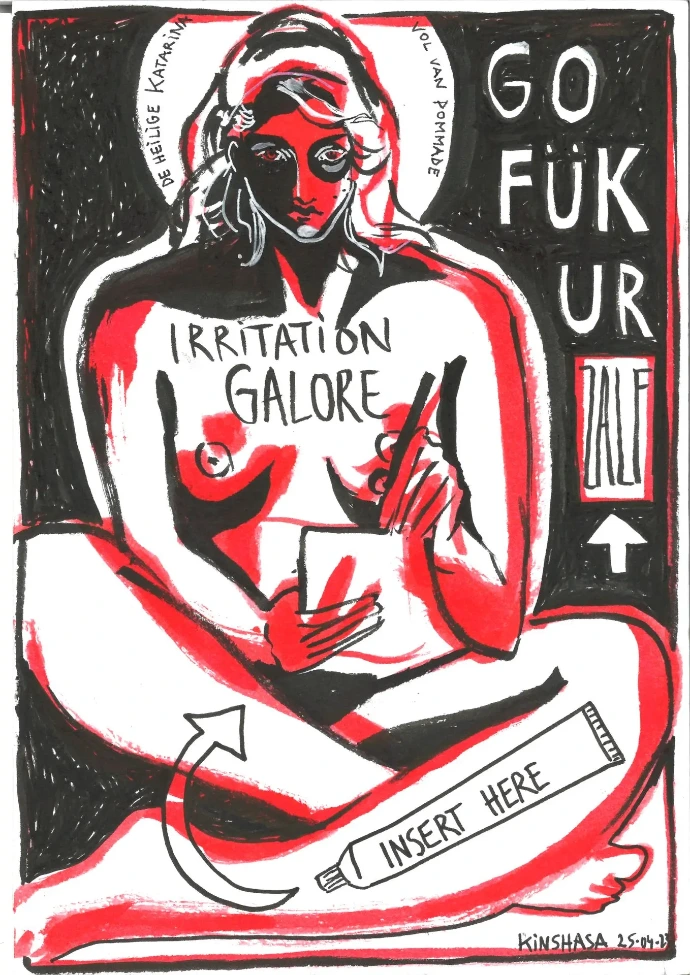
Here begins the story of Kat Bové, here her action and reaction start. It begins well, as you read her works: ‘Get all the color, fall for my part all red’, or also ‘Fük yü, I’m doing my güsting anyway’.
Like a mythical Salome, she proudly presents the severed head of John the Baptist. An iconic image of a woman who refuses passivity, who no longer wants to be merely a mirror of male projections. In her work, Salome embodies the fear and desire that female sexuality evokes: a figure of transgression that reveals that the existing order is not a natural law, but a construct. In the central triptych of ‘Minsterwood’, Wayn Traub's grand exhibition at the River City Gallery in Bangkok (January-March 2026), she appears at the top of the altarpiece, triumphant, her head bathed in a golden halo, her hand resting on the sword.
From a liberated body, she goes on the counterattack. Her practice is both autobiographical and art historical. Humor and melancholy constantly intersect and outline a nameless path where vulnerability and intimacy, pain and healing collide and merge. Therefore, she invites us into her very own liminal space, a shifting threshold where taboo, prohibition, and desire touch each other.
Her tone is unforgettable: irreverent, rebellious, hot. A new mythology emerges before our eyes, with old frameworks bursting open and new ones that fascinate and send shivers down the spine. It becomes urgent to think differently, to dream again of worlds that have remained closed for too long.
Since 2022, through a daily gaze at herself, the masks have fallen. On Instagram, the layers of social varnish dissolved, exposed to the astonished gaze of the world. Since then, Kat exists artistically ‘live’, in a continuous self-exhibition: an intimate performance she calls ‘Kat-alogus’, not a diary, but a place of revelation, an inner space in which she resides.
‘Give me a sketchbook to live in’: this is how the art book published in 2026 by the DeNode Foundation in Ghent opens and closes, nearly 300 pages thick, a gem to cherish. More than twenty years of inner struggle are depicted within, populated by angels and demons. It begins with the warning, DON’T READ A WORD IN THIS DIARY, OTHERWISE KARMA WILL FIND YOU and ends with a curse, FUCK THE PEOPLE. In between: the desire and at the same time the refusal to speak and be present in a world that often feels absurd, empty, and grotesque.
Like with Bracha Ettinger, whose figures appear and disappear on the edge of shadow, Kats' bodies are never fully present or absent. They float in a space permeated with archaic images, traveling archetypes. We encounter primal mothers, ancestral goddesses, drawn in rough, almost wild gestures. A painting of the essential, searching for the elusive. Desire, passion, aching loneliness — everything comes to the surface. The bodies, as if in a trance, appear in worlds that one could call, with Rudolf Otto, fascinans and tremendum: simultaneously seductive and unsettling, attractive and frightening.
The skin seems close, almost tangible, a provocative invitation for everyone’s gaze. The repetition of identical bodies works hypnotically, always charged with intimacy and sensuality, also laden with disruption and stubbornness. Bodies desire, suffer, exhaust themselves, often fail, for a dark energy resides within them. Bodies catch something, radiate it, open up, and then repel again. Perhaps they implode. Perhaps they explode.
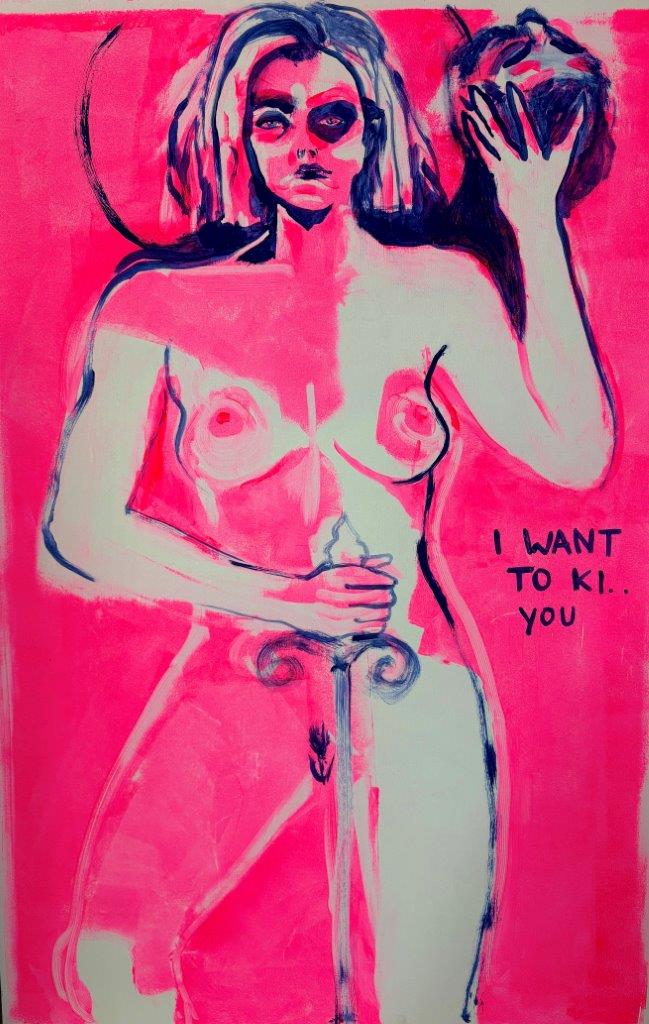
Kat's women are shamanistic princesses. They seem to be in conversation with other worlds and live in transition zones that transcend the human. In these In-Between Worlds, emotions contradict each other: wanting to feel, not being able to feel, a recurring longing for the wound amidst happiness. And in the heart of this space appears The First Scream, a powerful homage to Munch, his naked Madonna also comes into view, a once-lost sacredness in times that are sometimes already thought to be lost. Why do Scream and Madonna inhabit her inner world? Out of social anxiety? Existential unrest? Broken relationships? Or from cosmic dizziness? One thing remains: something transcends, escapes, repeats itself, multiplies. Female bodies move between fullness and emptiness, between attraction and repulsion, amidst fields of tension and transgression.
Where Irigaray saw the woman still trapped in a masculine language, Kat creates a new relationship between word and body. The bodies speak. They respond, speak against, question the image they themselves inhabit. They become 'Speaking Portraits', a new artistic genre? Not illustrations, but inner monologues that open themselves to dialogue. Bodies play a sophisticated game, transform, question themselves. Nothing is stable. Meaning slips.
No instability, however, without many forms of hilarious joy. Kat creates an imagination where laughter feels at home, irreverent, relaxing. ‘YOU WANT MEUR?’ asks a liberated armpit. ‘REBEL WITHOUT A KOUS’, complains a left leg.
Unstable portraits blow up the old mythology, patriarchal fictions from Church and State wobble. In Kat's mythology, the woman claims the golden halo on her own terms. The body, the heart of this exhibition, is no longer an instrument. It became a sovereign territory. In the moving space between fascinans and tremendum, it becomes a symbolic battlefield between old and new regimes of light.
Her motto remains: I own me.
And no one should interfere with it.
Because: I will always rise in wild fires.
Kat claims the mythical sanctity of fire and light, not as a gift from above, but as an inner source. Therefore, she is no longer a muse, nor a victim. Neither Eurydice, nor Persephone.
She becomes origin.
And with her, each of us can become that.
It suffices to open the eyes.