
Kat Bové is a sight: in bright colors and leopard prints, she seems to dance through life. Yet she also has a dark side, one that she doesn't often show. Behind the cheerful facade lies an introverted woman, who has been working out her demons, doubts, and questions on paper for years. For herself, but recently also for the general public. For her latest exhibition WHO IS YOUR GOD WHERE IS SHE, she shares her eternal search for that duality within herself. And she invites others to search for the gods that guide them, amidst a dark world, towards the light.
Many of your works seem funny at first glance, but if you think deeper about them, they also have a lonely aspect. Do you see that yourself?
That loneliness often creeps into my work, yes, just like in real life. Perhaps everyone feels lonely at times, but it can really overwhelm me, like an echo from the past. That past is my childhood, during which I was sent to boarding school at the age of eight, even though I didn't want to at all. I ended up at a girls' boarding school where everyone was older than me.
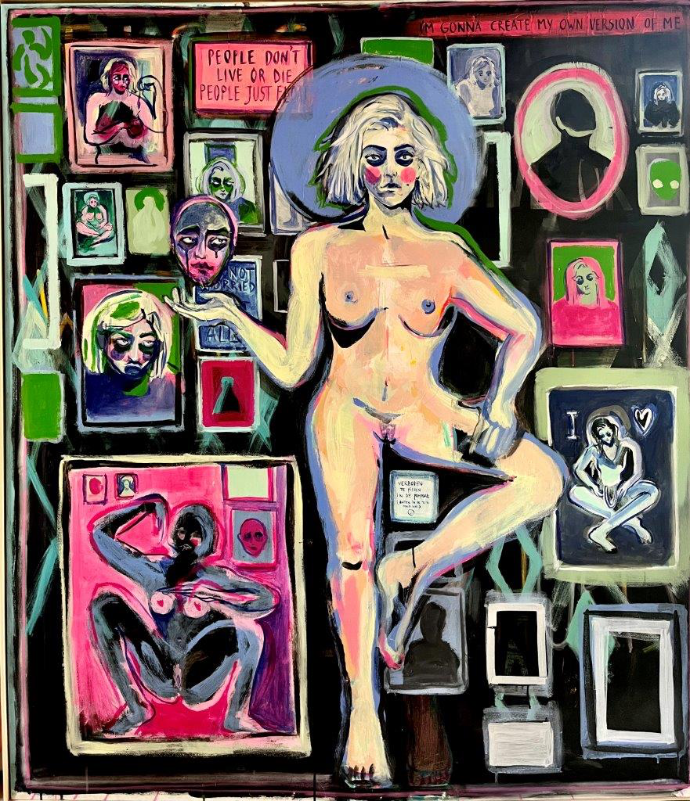
I found it hard to connect, not even with classmates, and felt intensely unhappy all those years. I sometimes joke about it, 'Shall we talk again about my traumatic childhood?', but it was traumatic, I can't get around that. It seeps through in what I create, especially because I thought for a long time that I never wanted to exhibit. The works I made, I made purely for myself, and gradually they formed a world in which I felt good.
However, anyone looking at your works sees strong women, often yourself, who humorously poke fun at various clichés...
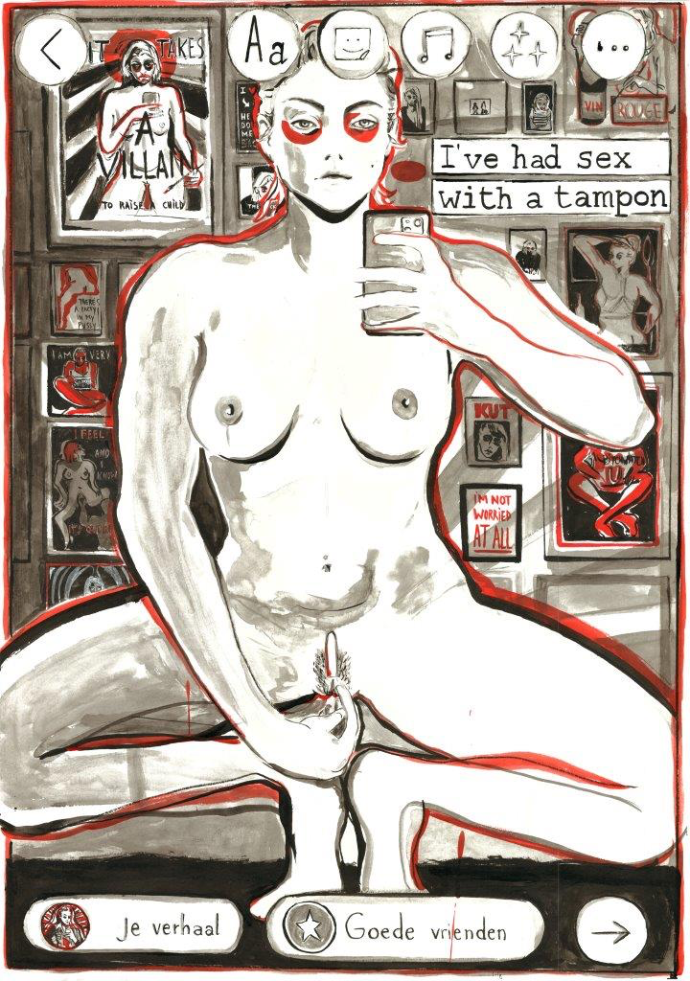
The women are who I would like to be. Especially in my self-portraits, that element is very strongly present. I create a powerful version of myself, hoping to take on some of that strength. But those who look closely will discover an extra layer each time, one in which I break through that façade. That is something I struggle with: when I go out, people see an extroverted version of myself, but when I come home, I prefer to disappear into my studio, like a hermit, far from everyone. Sometimes I feel like a clown performing a number, which I then incorporate into many of my paintings. Is that extroverted side fake? Or do I just need it to function? I don't know, although I feel that those masks are becoming heavier for me. Because my works were initially only for myself, you see that search recurring. It is truly one of the big questions in my life.
For years you kept your work hidden from the public. What made you decide to exhibit your work?
That idea had to grow. I still prefer to keep each work close to me, in my studio, but gradually I began to understand that my works can also mean something to others. And that it is also beautiful, such a painting that finds its way to someone who benefits from it. Many friends have asked me if they could buy something from me, and for a long time I said no, but in the meantime, I have gotten used to the idea. My brother, himself an artist, played an important role in that. He convinced me to occasionally post a work on Instagram. That made me accustomed to the idea of an audience. And when the question came whether I wanted to exhibit at the Zeepziederij in Bree, I gave in. That half-industrial space just felt right; I could already see my works hanging there.
What did your first exhibition bring about?
To my surprise quite a lot. There was media interest, people started buying my work and above all: they saw something in it, found it useful, were touched by it. I heard someone explain that he bought the work for his girlfriend in the hope that she would draw strength from it. You can't give me a nicer compliment. It also makes it easier to let works go.
The media attention mainly focused on the fact that you are a flight attendant and even constantly pull out your brushes while on the go.
On the plane, at yet another pool with yet another new crew… Those brushes travel everywhere with me. I have a whole folder full of drawings of colleagues. For me, that is a safety net. If we get stranded somewhere for two or three days with the crew, my hotel room becomes my studio. When I mingle with the crew, I always have my cocoon of pen and paper at hand. While my colleagues talk, hang out, play, I am busy portraying them.
In Nodenaysteen we do not get to see the portraits of your colleagues. What can we expect from WHO IS YOUR GOD, WHERE IS SHE?
A quest, or what did you think? (laughs) I mainly show a lot of self-portraits, but in an idealized form, in the form that I and by extension many people want to be: witty, powerful, sometimes with a middle finger raised to society. Do not expect any clarity, I have more questions than answers. Each image plays with contrast, with confusion, with a contradiction. The vulnerability of the naked body versus the strength of iconography, the conflict between image and text, the humor of a message versus the dreary reality. Light versus dark, color versus black. I want to show that it’s okay to have both within you, as long as you have some 'gods' to guide you towards the light. For me, those are women: bearers of the world, exemplars of strength. I portray some of my heroines, but especially that idealized version of myself, which if you look closely always has a vulnerable side somewhere. The title of the exhibition is actually taken from the song Multi-Love by Unknown Mortal Orchestra, as a nod to the way quotes from music and literature often sneak into my work.
Lastly, this: you have painted only for yourself for years, it didn’t need words, you understood perfectly what you were doing. What is it like to suddenly have to explain your work?
That is also a quest. For me, all those words are actually unnecessary. Let my works speak for themselves. They already scream more than enough