
No one could have painted a Van Eyck before the development of oil paint, no one could have made a Courbet before the industrial revolution, and no one could have created a Dali before the emergence of psychoanalysis. Thus, it turns out that the art we call timeless is actually always very timely. It is always the product of the technology and ideology in which it was baptized. This is also the case with the work of Kat Bové.
Her work shamelessly imitates mirror selfies, refers to the Instagram interface, and parodies influencer culture. Her work is made using materials such as fluorescent acrylic paint, graffiti, and Posca markers. Her style is influenced by cartoons and advertising art. The hyper-contemporary iconography she employs will be as cryptic for future generations as that of Greek amphorae or Egyptian sarcophagi. In every possible way, Bové's art reflects the moment it was created. Nowhere is this clearer to me than in the way the artist engages with one of the central themes of the exhibition: femininity.
The history of Western feminism is often divided into three phases, or waves. The aim of the first wave was to gain the same rights as men. But as these rights were acquired drop by drop, other complexities came into view. Second-wave feminists realised that women's oppression was due not only to explicit institutional inequality, but also to a whole set of gender norms subtly upheld by everyone, including women themselves.
This second wave culminated in a feminism that radically opposed everything experienced as "typically feminine". Away with pink dresses and make-up – a real feminist wore jeans and let her armpit hair grow. She had no husband and no children. She was not well-behaved, cheerful or cute, but hard, stoic and radical.
Although feminism gained much theoretical depth in this second wave, it unfortunately also gained a bad name. More and more women felt alienated and excluded from this kind of feminism. So in the 1990s the third wave arose: a feminism for everyone. Whether you are a Muslim woman with a headscarf, a lesbian trans woman, a sex worker or a flight attendant, all that matters is that you feel good in your gender identity and sexuality. It is of course this ideology that Bové's work radiates. Her nude self-portraits, with blushing cheeks and big eyes, seem to match perfectly the traditional image of woman in our society. Except in one respect: that shame gives way to pride.
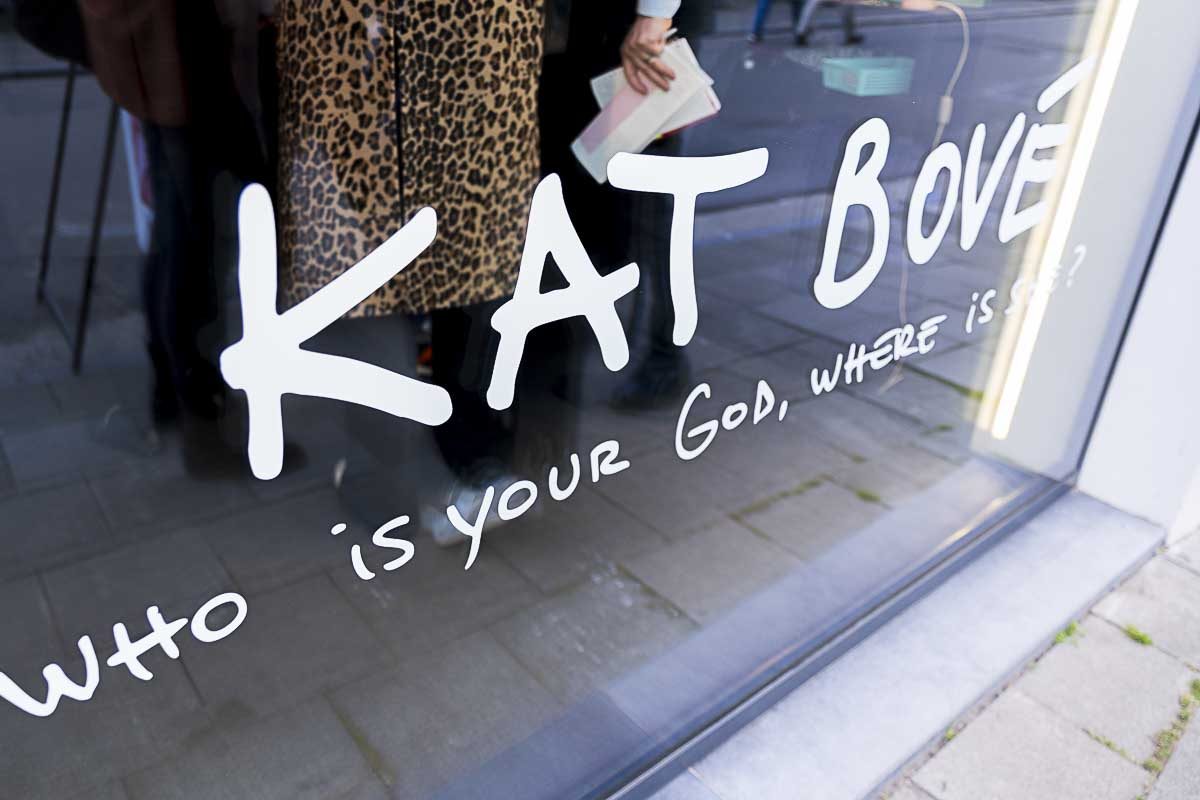
The title of the exhibition is "Who is your God, where is she?" When you step inside, an answer to that question seems to present itself quickly. Bové portrays herself as if she is an icon of a saint, with a halo behind her head and a sword in her hand. Female empowerment seems to turn into tasteless narcissism. An impatient viewer might walk out of Bové's church with that conclusion. However, the observant art lover will soon see that behind all the beautiful appearances lies an insecurity. Bové seems to plead with her viewers: find me beautiful, consider me strong, declare me holy! In the inscriptions of her works, these insecurities are often made explicit as well. It is this dimension that makes Bové's work truly fascinating for me. In this exhibition, I saw not only the reflection of the third feminist wave, but I also encountered the limits of that philosophy. It is a philosophy that asks us to find a gender expression and sexual experience in which we can be confident, but denies the fact that our identity is always dependent on its recognition by others.
Not long after the Van Eyck brothers painted the Ghent Altarpiece, Martin Luther would renounce this kind of painting and unleash the iconoclasm. In fact, it was precisely this kind of Renaissance art that spurred reformism. Great art is not only timely; it always reveals the limits of its own zeitgeist. So it is with Bové's work. She pushes the third wave to the point where it will have to make way for a fourth. The exhibition is like a church that challenges its visitors to commit an iconoclasm. It is timely, and only thereby timeless.