No one could have painted a Van Eyck before the development of oil paint, no one could have made a Courbet before the industrial revolution, and no one could have created a Dali before the emergence of psychoanalysis. Thus, it turns out that the art we call timeless is actually always very timely. It is always the product of the technology and ideology in which it was baptized. This is also the case with the work of Kat Bové.
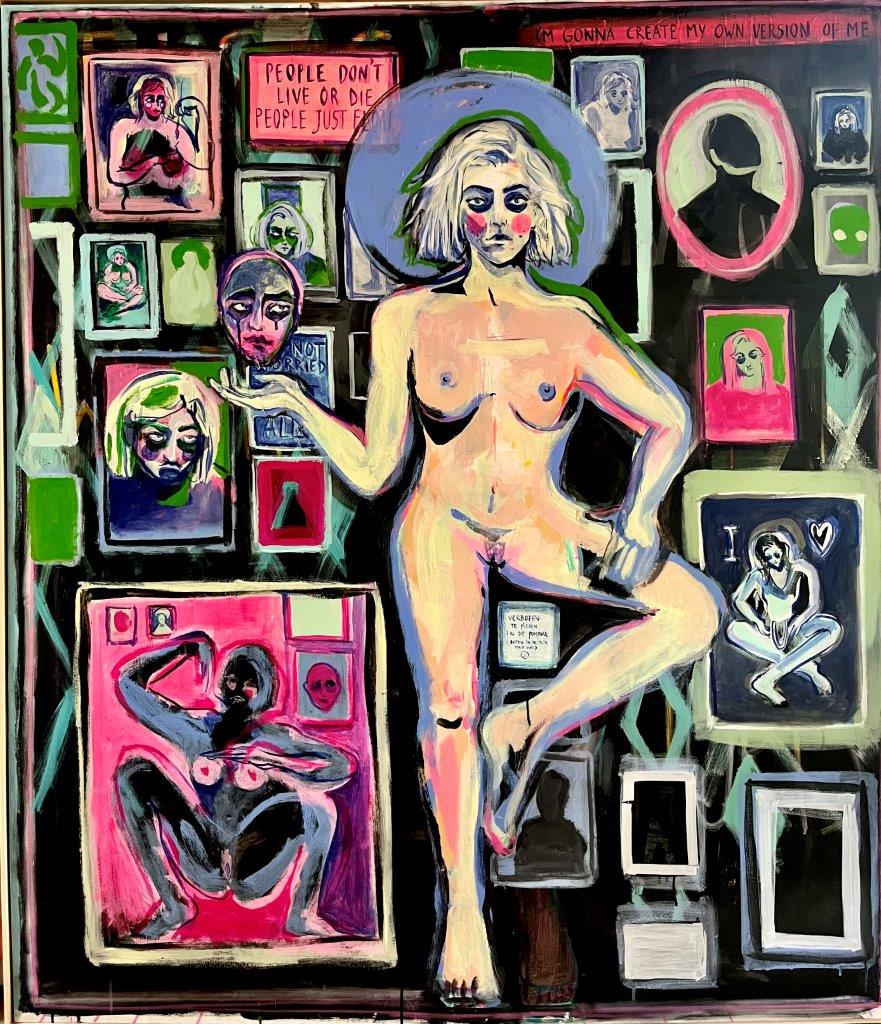
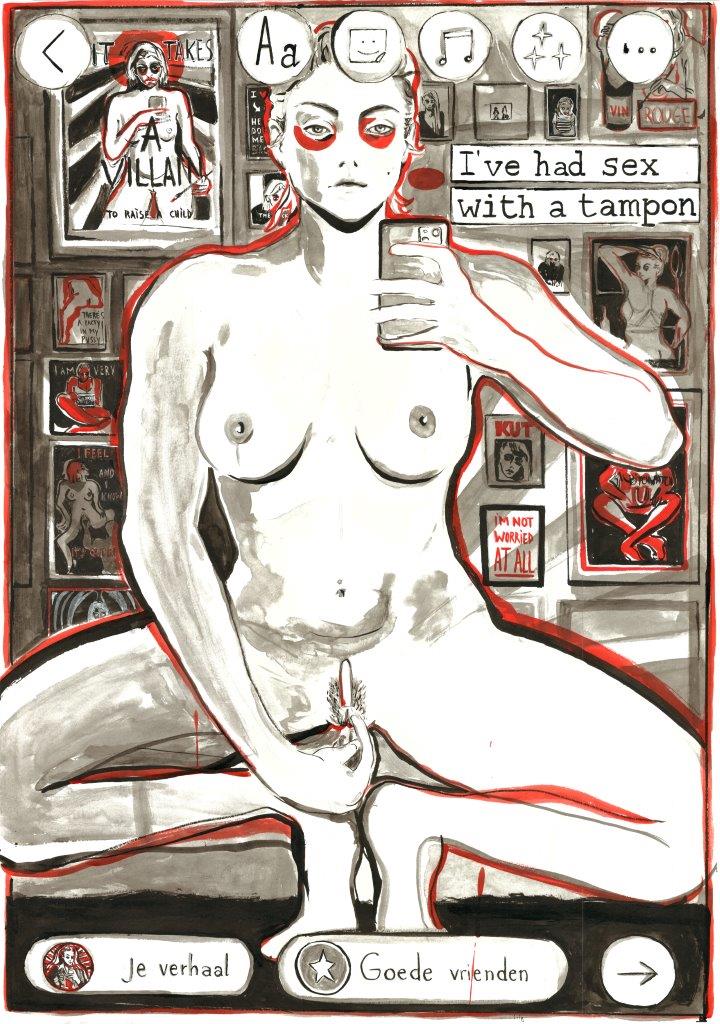
Her work shamelessly imitates mirror selfies, refers to the Instagram interface, and parodies influencer culture. Her work is made using materials such as fluorescent acrylic paint, graffiti, and Posca markers. Her style is influenced by cartoons and advertising art. The hyper-contemporary iconography she employs will be as cryptic for future generations as that of Greek amphorae or Egyptian sarcophagi. In every possible way, Bové's art reflects the moment it was created. Nowhere is this clearer to me than in the way the artist engages with one of the central themes of the exhibition: femininity.
De geschiedenis van het Westerse feminisme wordt vaak opgedeeld in drie fases, of golven. Het doel van de eerste golf was het verwerven van dezelfde rechten als mannen. Met het druppelsgewijs verwerven van deze rechten kwamen er echter een andere complexiteiten in beeld. Tweede golf feministen hadden door dat de onderdrukking van de vrouw niet enkel te danken was aan expliciete institutionele ongelijkheid, maar ook aan een hele hoop gendernormen die op subtiele wijze door iedereen, inclusief vrouwen zelf, in stand werden gehouden.
Deze tweede golf culmineerde in een feminisme die zich radicaal verzette tegen alles dat als “typisch vrouwelijk” werd ervaren. Weg met roze jurken en make-up – een echte feminist droeg jeansbroeken en liet haar okselhaar staan. Ze had geen man en geen kinderen. Ze was niet braaf, goedlachs of schattig, maar hard, stoïcijns en radicaal.
Hoewel het feminisme in deze tweede golf veel theoretische diepgang verwierf, verwierf het helaas ook een slechte naam. Steeds meer vrouwen voelden zich vervreemd en uitgesloten van dit soort feminisme. Zo ontstond in de jaren 90 de derde golf: een feminisme voor iedereen. Of je nu een moslima met een hoofddoek bent, een lesbische transvrouw, een sekswerker, of een stewardess, het enige dat ertoe doet is dat je jezelf goed voelt in je genderidentiteit en seksualiteit. Het is natuurlijk deze ideologie die het werk van Bové uitstraalt. Haar naakte zelfportretten, met blozende wangen en grote ogen lijken perfect overeen te stemmen met het traditioneel vrouwbeeld van onze samenleving. Althans, op één aspect na: dat schaamte er plaatsmaakt voor trots.
The title of the exhibition is “Who is your God, where is she?” When you step inside, an answer to that question seems to present itself quickly. Bové portrays herself as if she is an icon of a saint, with a halo behind her head and a sword in her hand. Female empowerment seems to turn into tasteless narcissism. An impatient viewer might walk out of Bové's church with that conclusion. However, the observant art lover will soon see that behind all the beautiful appearances lies an insecurity. Bové seems to plead with her viewers: find me beautiful, consider me strong, declare me holy! In the inscriptions of her works, these insecurities are often made explicit as well. It is this dimension that makes Bové's work truly fascinating for me. In this exhibition, I saw not only the reflection of the third feminist wave, but I also encountered the limits of that philosophy. It is a philosophy that asks us to find a gender expression and sexual experience in which we can be confident, but denies the fact that our identity is always dependent on its recognition by others.
Niet lang nadat de gebroeders Van Eyck het Lam Gods schilderde, zou Maarten Luther dit soort schilderkunst afzweren en de beeldenstorm ontketenen. Sterker nog: het is juist dit soort renaissance kunst die het reformisme aanspoorde. Grote kunst is niet alleen tijdig, ze onthult ook steeds de limieten van haar tijdsgeest. Zo is het ook met het werk van Bové. Ze duwt de derde golf tot het punt dat het plaats zal moeten maken voor een vierde golf. De expo is als een kerk die haar bezoekers uitdaagt een beeldenstorm te plegen. Het is tijdig, en enkel daardoor, tijdloos.
Jakob de Smaele